
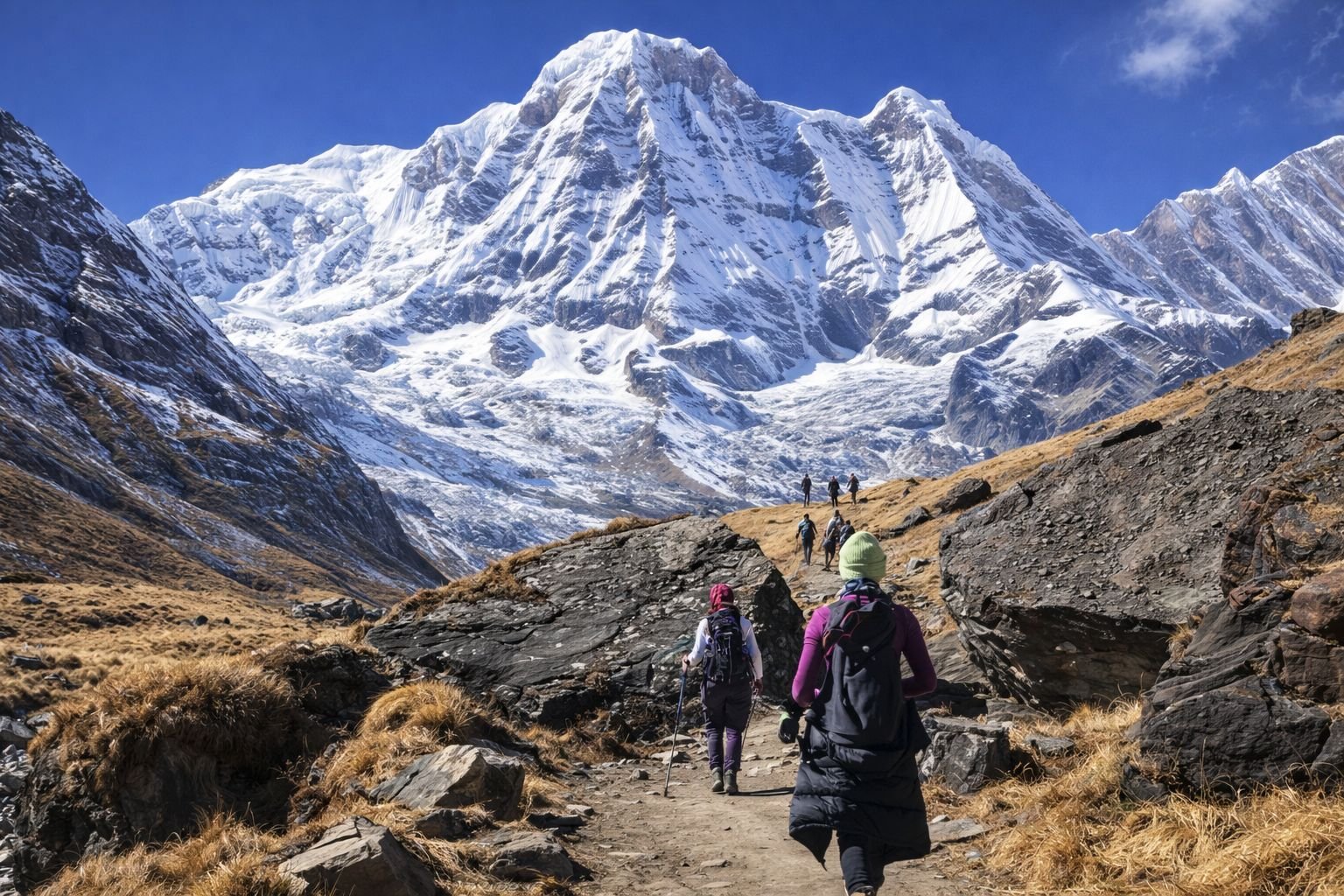
So, you’re dreaming of the Himalayas. You’ve seen the photos of jagged peaks, prayer flags, and rhododendron forests. But let’s be honest: planning a trek to the Annapurna region can feel overwhelming. Do you need a guide? What if you get altitude sickness? Is the internet reliable?
Why this matters for you: Travelers value safety, time efficiency, and authentic experiences. This guide cuts through the outdated blogspam and gives you the latest facts—from packing lists to permit costs—so you can trek with confidence.
10 Key Things to Know Before Trekking Annapurna
1. Choose the Right Circuit
The Annapurna Region has three main treks. Most beginners default to the “Annapurna Circuit,” but that might be wrong for you.
- Annapurna Base Camp (ABC) – Best for beginners (5-7 days): You walk into a natural amphitheater surrounded by 7,000 m peaks. Lower altitude risk than the Circuit.
- Annapurna Circuit – Best for endurance hikers (12-18 days): Crosses the Thorong La Pass (5,416 m). Requires prior high-altitude experience.
- Ghorepani Poon Hill – Best for time-crunched hikers (3-4 days): Sunrise views of Annapurna I and Dhaulagiri. Great for families.
Expert tip: 70% of first-timers who quit do so because they chose the Circuit over ABC. Start with ABC to test your legs.
2. Budget Realistically
Many blogs claim you can trek for $15/day. That’s outdated and dangerous!
Mandatory permits:
- ACAP Permit: 3,000 NPR (~$23 USD) – Annapurna Conservation Area Project
- TIMS Card: 2,000 NPR (~$15 USD) – Trekkers’ Information Management System
Daily budget (tea houses + 3 meals + snacks):
- Budget: $25-35/day (basic room, dal bhat, no hot shower)
- Comfort: $40-60/day (private room, hot shower, battery charging, beer)
Internal link suggestion: Anchor text: “Detailed Nepal trekking budget breakdown” → Link to /nepal-trekking-cost-2025
3. Pack Smart: The 15 lbs / 5 kg Rule
Your porter (if you hire one) will thank you. So will your lungs at 3,500 m.
Do not bring:
- Jeans (they freeze, never dry)
- More than 2 t-shirts
- A full-sized laptop (leave it in Kathmandu)
Non-negotiable items (Trekkers overpack these most often):
- Down jacket (rent in Thamel for $1/day – don’t buy)
- Water purification (Grayl GeoPress or Aquatabs – plastic bottles are banned in upper Annapurna)
- Power bank (20,000 mAh minimum – tea houses charge $3-5/hour for outlets)
External authority link suggestion: Anchor text: “REI’s high-altitude layering system” → Link to https://www.rei.com/learn/expert-advice/altitude-layering.html
4. Acclimatize Like a Pro
Altitude sickness doesn’t care about your fitness. We’ve seen marathon runners go down at 3,000 m.
The golden rule: Above 3,000 m, don’t increase sleeping altitude by more than 300 m per day.
Annapurna-specific danger zones:
- ABC route: Deurali to ABC (800 m gain in one day) – take a rest day at Deurali.
- Circuit: Thorong Phedi to High Camp (600 m gain) – many trekkers skip this. Don’t.
Actionable tip: Buy a pulse oximeter ($25 on Amazon). If your SpO2 drops below 85% at rest, descend immediately.
5. Hire a Guide or Go Solo?
Solo trekking is legal in Annapurna (unlike Everest region). But should you?
Hire a guide ($25-35/day), if:
- You have no high-altitude experience
- You want someone to handle permits, lodging, and medical checks
- You’re trekking in winter (Dec-Feb) – snow navigation is tricky
Go solo, if:
- You’ve done 3+ multi-day treks above 4,000 m
- You speak basic Nepali (greetings, numbers for bargaining)
- You’re comfortable making quick medical decisions
Trusted guide agencies: Himalayan Guide Nepal (registered with TAAN) or Three Sisters Adventure Trekking (women-led).
6. Internet & Connectivity
You will not have 5G. And that’s the point. But for emergencies:
- WiFi: Available in most tea houses up to 3,500 m. Costs $3-5 per device. Speeds? Enough for WhatsApp text, not video calls.
- NCell SIM card: Buy at Kathmandu airport. LTE stops at Chame (Circuit) or Sinuwa (ABC). After that, it’s SMS only.
- Satellite messenger: Carry a Garmin inReach Mini 2 on every trek. Rent one in Pokhara for $10/day.
External authority link suggestion: Anchor text: “Official Nepal Telecom coverage maps” → Link to https://ntc.net.np/coverage-map
7. What Food Is Safe?
Diarrhea at 4,000 m is a medical emergency (dehydration + altitude = bad news).
Safe bets:
- Dal Bhat (lentil soup + rice + veggies) – it’s boiled, hot, and all-you-can-eat for $5-7
- Fried noodles (chow mein) – high calorie, cooked fresh
- Garlic soup – local remedy for altitude sickness
Avoid:
- Buff mo:mo (dumplings) – meat sits out in warm kitchens
- Raw salads (washed in tap water)
- Dairy (unless boiled in tea)
Pro tip: Bring Cipro (antibiotic) from your GP before leaving. In Nepal, you can buy it over the counter, but counterfeit meds exist.
8. Best Time to Go (And When to Absolutely Avoid)
Travelers often book for summer holidays (July-August). That’s a mistake.
Prime windows:
- Mid-September to November: Crystal clear skies, 15-20°C days. Busiest (book tea houses 2 weeks ahead).
- March to May: Rhododendrons in bloom. Some afternoon clouds. Less crowded.
Avoid:
- June to August (Monsoon): Leeches, slippery trails, no mountain views. Seriously, 90% of search and rescue calls happen in July.
- December to January: ABC trail can be knee-deep snow. Only for experienced winter trekkers.
Internal link suggestion: Anchor text: “Month-by-month Nepal trekking weather guide” → Link to /nepal-weather-best-trekking-months
9. Physical Training (Don’t Just Walk Your Dog)
The Annapurna trails have 1,000+ stone steps per day. Your knees will hate you if you don’t prep.
8-week prep plan (for ABC – moderate difficulty):
- Cardio: 45 mins stairmaster or incline treadmill (12% grade), 4x/week
- Strength: Squats, lunges, and calf raises (bodyweight is fine)
- Practice with a weighted pack: Start 10 lbs, work up to 25 lbs
Test: Can you hike 8 miles with 2,000 ft elevation gain in under 4 hours? If yes, you’re ready.
10. Insurance That Actually Covers Annapurna
Most travel insurance (even “premium” plans) excludes trekking above 4,000 m. Read the fine print.
Must have in your policy:
- Helicopter evacuation up to 5,500 m (minimum $100,000 coverage)
- High-altitude trekking explicitly named (not “mountaineering” – that’s climbing with ropes)
Trusted for Trekkers:
- World Nomads (covers ABC up to 6,000 m)
- SafetyWing (better for digital nomads, but check altitude rider)
- Global Rescue (medical evacuation membership, not insurance – but gold standard)
True story: A Canadian client in 2024 had “full coverage” from a major bank. HACE at 4,200 m. Helicopter evacuation cost $7,500. Bank denied claim. She paid out of pocket. Don’t be her.
External authority link suggestion: Anchor text: “American Alpine Club’s rescue insurance checklist” → Link to https://americanalpineclub.org/insurance
FAQs
Do I need to tip porters and guides?
Yes. The standard in Annapurna is 15-20% of their daily wage. For a guide making $30/day, tip $5-6 per day of the trek. Porters (who carry 20-25 kg) get $4-5/day. Give cash directly – don’t leave it at the tea house.
Can I charge my phone/camera on the trail?
Yes, but it costs $2-5 per hour. Bring a power bank. Solar charges are unreliable in the gorge (ABC route gets only 3 hours of direct sun).
Is it safe for solo female trekkers?
Generally yes – Annapurna is well-traveled and local communities are used to foreign women trekking alone. However, take standard precautions: avoid trekking after 4 PM, share a tea house room with other women if possible, and carry a personal alarm.
What happens if I get seriously sick?
Every tea house has a “sick book” with emergency contacts. The nearest clinic is in Jomsom (Circuit) or Chhomrong (ABC). For true emergencies, your insurance coordinates a helicopter from Pokhara. Average response time: 45-90 minutes in good weather.
Do I need a sleeping bag?
Tea houses provide blankets, but they are rarely washed. Rent a -10°C sleeping bag in Thamel ($1/day) or bring your own lightweight bag (e.g., Sea to Summit Spark SP II). Do not buy a cheap bag on Amazon – it will fail at 4,000 m.
Conclusion
Let’s recap the non-negotiables:
- Pick the right route – ABC for beginners, Circuit for experts.
- Budget $50-60/day for a stress-free experience.
- Pack under 15 lbs and rent your down jacket in Nepal.
- Get real insurance that covers 5,500 m heli-evac.
- Train stairs – your quads will carry you to base camp.
You now have the same checklist we give our private clients. The Annapurna region is life-changing – we’ve watched hardened New York bankers cry at sunrise on Poon Hill. But it rewards preparation, not luck.
Ready to book your trek? Download our free Annapurna Packing Checklist PDF (no email required) → Click here
Or, keep reading:
- How to Choose Between Everest Base Camp vs Annapurna
- 10 Nepali Phrases That Will Save You Money on the Trail
- What to Do in Pokhara Before Your Trek (3-Day Itinerary)