
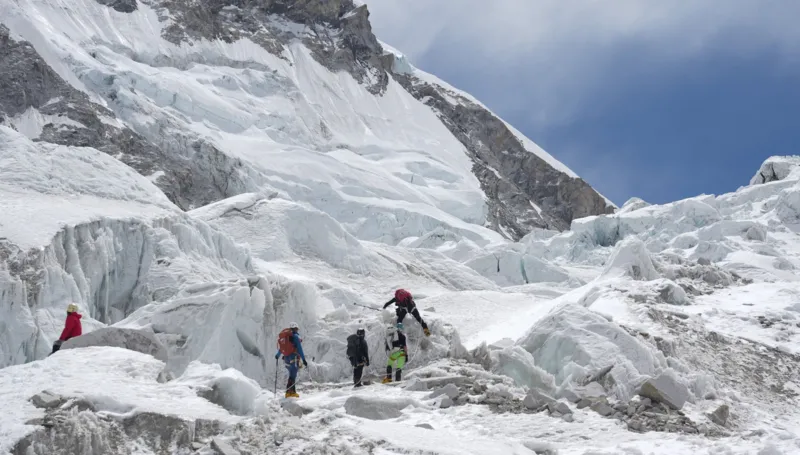
A massive and unstable section of glacier is obstructing the primary ascent route on Mount Everest from Base Camp in Nepal, just as the peak Himalayan climbing season begins.
Specialist “icefall doctors,” responsible for installing ropes and ladders along the lower section of the world’s highest mountain, have been unable to navigate around the approximately 100-foot (30m) ice formation located below Camp 1.
The team reports that the only viable course of action is to wait for the formation—known as a serac—to melt naturally, a process they hope will take several days.
The disruption has pushed preparations weeks behind schedule for the critical spring climbing window, when conditions for summiting Everest are typically most favorable. Concerns are mounting that delays could lead to congestion near the summit once climbing resumes.
Purnima Shrestha, a prominent Nepali climber and photographer currently acclimatising for her sixth Everest summit attempt, highlighted the risks posed by the delay.
“We usually climb between Camp 1, Camp 2 and Camp 3 back and forth during this acclimatising process. Delays in the opening of the route have added concerns of possible ‘traffic jams’ to the peak this year,” she told the BBC from Base Camp.
The icefall doctors operate under the Sagarmatha Pollution Control Committee (SPCC), the body tasked with securing the climbing route up to Camp 2 on Everest, which stands at 8,848.86m (29,031 feet). The team arrived at Base Camp three weeks ago.
Under normal circumstances, the route would be established up to Camp 3 by mid-April. However, progress remains halted by the glacier block situated roughly 600m below Camp 1.
“We haven’t found artificial ways to melt it so far, so we don’t have any options other than to wait for it melting and crumbling itself,” SPCC base camp co-ordinator Tshering Tenzing Sherpa told the BBC.
Veteran icefall doctor Ang Sarki Sherpa expressed cautious optimism that the serac will collapse naturally, noting signs of weakening at its base.
“We reached it on 10 April. The crevasse below is melting,” he said, adding that Sherpas after him said it had melted further and was close to collapsing.
Despite extensive assessments, climbers have found no safe way to bypass or scale the formation. Establishing an alternative route to Camp 1 has also been deemed highly challenging this season.
“There is no choice. We spent four days touring the area, looking at every place from the mountain to the right and left,” Ang Sarki Sherpa said over the phone from Base Camp.
Nepal’s Department of Tourism is now evaluating contingency measures, including the possibility of airlifting rope-fixing teams and equipment directly to Camp 2.
“We are thinking about airlifting the rope-fixing team and their logistics to Camp 2 by helicopter, so they can open the route above that altitude for now,” said Ram Krishna Lamichhane, the department’s director general.
“We will wait for the ice to melt at the place where there is an obstruction and work there when everything is safe.”
With favorable weather conditions expected only until the end of May, Sherpa teams are aiming to complete route preparations to Camp 2 within days of the obstruction clearing, followed by summit pushes within a week.
However, Shrestha cautioned that even a prompt reopening of the route could result in a compressed climbing window.
“I am not worried that the route won’t open because we still have time for that. But the window could be narrow – with lots of climbers having to make their attempts in a short period of time.”
Despite geopolitical tensions, including the ongoing Iran conflict and its impact on travel costs, Everest is still expected to attract a significant number of climbers this season.
“There has been a slight decrease due to the impact of flights, but mountaineering has not been affected as much as trekking,” said Dambar Parajuli, president of the Expedition Operators’ Association.
According to Nepal’s Department of Tourism, 367 climbers have obtained permits so far, with the majority coming from China. Meanwhile, China has not issued permits for foreign climbers via its Tibetan route this year.
As a result, most expeditions continue to approach Everest from the Nepalese side, which saw more than 700 summiters last year, compared to around 100 from China.
In response to overcrowding concerns—highlighted by viral images of summit queues in 2019—Nepal has introduced stricter permit regulations and significantly increased climbing fees.
This season, spring climbing permits for foreign nationals have risen to $15,000 (£11,105), up from $11,000, while fees for Nepali climbers have doubled to $1,000.