
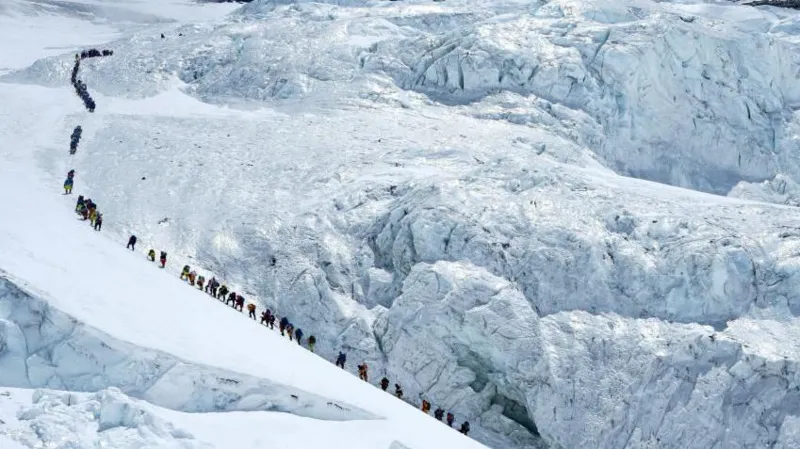
A record-breaking 274 climbers reached the summit of Mount Everest from Nepal on Wednesday, marking the busiest single-day ascent in the mountain’s history from the southern side.
The remarkable push came after a delayed start to the spring climbing season, caused by a massive block of ice that obstructed the route to the world’s highest peak.
Climbers took advantage of a brief window of favorable weather, with summit attempts beginning at 03:00 local time and continuing for nearly 11 hours, tourism department official Khimlal Gautam stated.
Wednesday’s achievement surpassed the previous record set on 22 May 2019, when 223 climbers successfully climbed Everest via Nepal’s southern route.
That same day in 2019, another 113 mountaineers reached the summit from the northern side in Tibet. However, China has closed the northern route to foreign climbers this season.
This year, nearly 500 foreign climbers have received permits to attempt Everest — another record figure — as mountaineering experts continue to raise concerns over overcrowding and safety challenges on the world’s most famous peak.
Most international climbers attempt the climb with at least one Nepali guide, who are not required to obtain permits.
Images shared across social media this week showed long queues of climbers moving slowly through the mountain’s infamous “death zone” — the extreme altitude region above 8,000 m where the human body struggles to survive.
At this height, most climbers depend on supplemental oxygen, and experts warn that even with oxygen support, time spent in the zone should ideally be limited to less than 20 hours.
Despite rising concerns, interest in Everest continues to grow. The surge in climbers comes even after Nepal increased permit fees last year, raising the cost from the long-standing $11,000 to $15,000 — the first increase in nearly a decade.
Expedition operators say congestion is a challenge but believe it can be controlled with proper planning.
“If teams carry enough oxygen, it is not a big problem,” Lukas Furtenbach of the Austria-based Furtenbach Adventures told Reuters news agency.
Some mountains in the Alps see thousands of climbers on their summits each day, he added. “So 274 is actually not a big number, considering this mountain is 10 times bigger.”
The record-setting week also saw legendary climbers and first-time Everest summiteers make headlines.
On Sunday, Nepali mountain guide Kami Rita Sherpa, 56, extended his own world record for the most Everest summits, reaching the top for the 32nd time.
The same day, 52-year-old Lhakpa Sherpa, widely known as the “Mountain Queen,” achieved her 11th Everest summit — a new personal milestone for the female climbing icon.
Russian climber Rustam Nabiev, 34, who lost both legs, also reached the summit without prosthetics, adding another extraordinary achievement to the season.
However, the climbing season has also been marked by tragedy.
Among those who lost their lives was Bijay Ghimere, the first mountaineer from Nepal’s underprivileged Hindu Dalit community to climb Everest. The 35-year-old reportedly died after suffering altitude sickness.
Phura Gyaljen Sherpa, 21, died after slipping on snow and falling into a crevasse near Camp 3 on Monday, while another guide, 51-year-old Lakpa Dendi Sherpa, died while heading toward Base Camp on May 3.
As Everest continues to draw climbers from around the world, this season has once again highlighted both the extraordinary achievements and the serious risks of reaching the planet’s highest point.